BACKGROUND
Migration and diaspora studies have increasingly challenged the assumption that political and social belonging is confined within the territorial boundaries of the nation-state. Scholars of transnationalism have shown that migrant communities sustain socio-cultural and political ties across borders, creating forms of belonging that extend beyond national territories (Glick Schiller et al., 1992; Levitt & Glick Schiller, 2004). At the same time, literature on nationalism and identity formation has emphasized the constructed and dynamic nature of national belonging (Anderson, 1983; Brubaker, 1996). More recent work has explored how identity is reproduced and negotiated through everyday practices and public events. However, existing research has paid limited attention to how large-scale global cultural events—such as international soccer competitions—serve as sites where diaspora communities actively construct and perform transnational forms of belonging. While sports have been studied in relation to nationalism, their role in shaping diaspora-based identity formation in host societies remains underexplored. This paper addresses this gap by examining how migrant communities transform global sporting events into symbolic spaces of belonging, thereby extending national identity beyond territorial borders.
INTRODUCTION
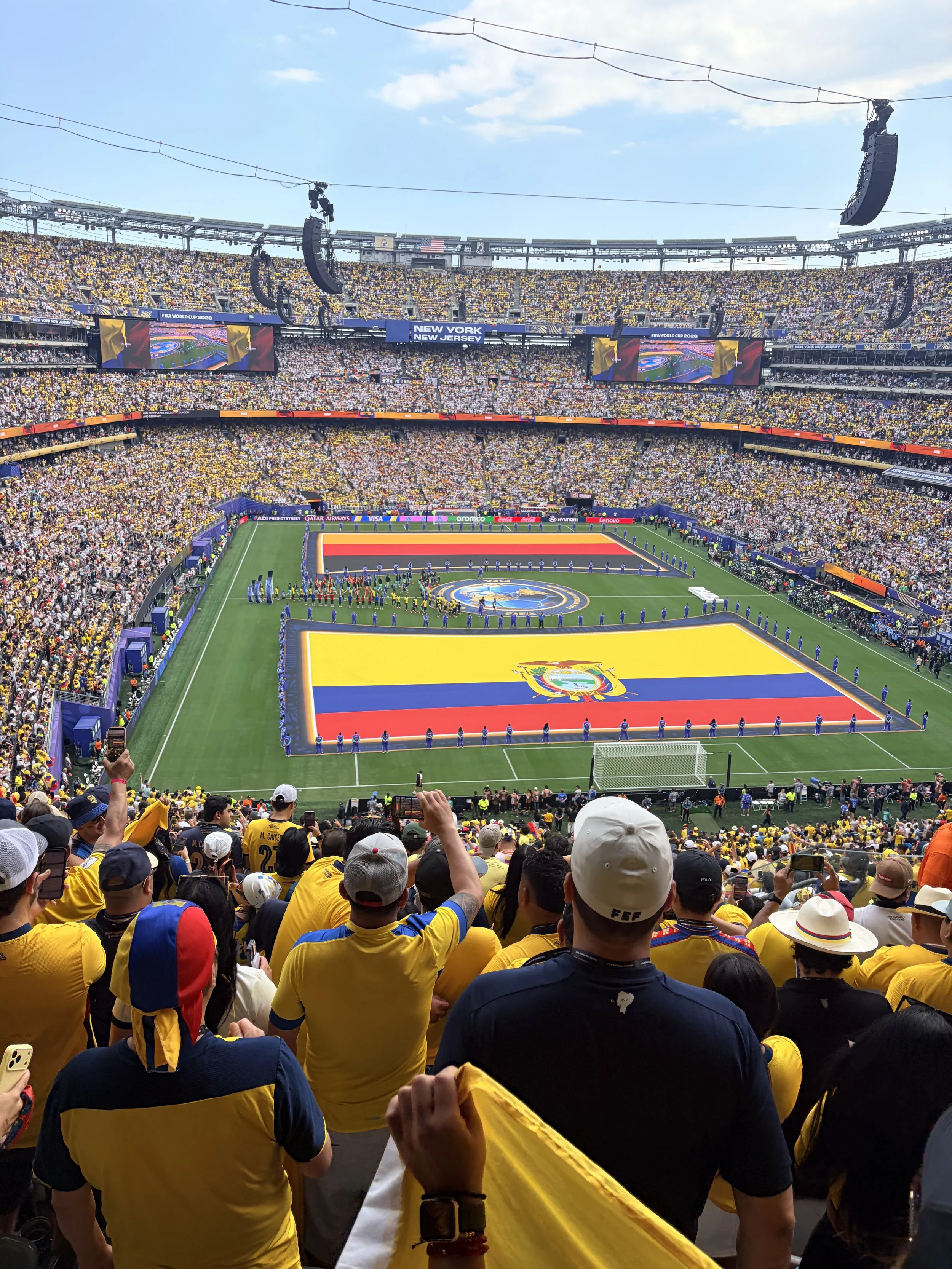
Over the years, Ecuadorians who have migrated to the tri-state area have established vibrant social communities that extend beyond their homeland, creating a broader symbolic geography. When Ecuadorian national team matches occur in the New York–New Jersey region, the stadium becomes more than a sports venue; it transforms into a temporary space of collective recognition where diaspora communities affirm their presence and cultural continuity. This paper, therefore, explores how migrant communities transform international sporting events into spaces of belonging, even while far from their countries of origin. It focuses on the Ecuadorian diaspora in the United States and their territorial expression through identities evident in international soccer events. It refers to the international football match between Ecuador and Germany at MetLife Stadium in June 2026 and examines how the Ecuadorian community in the tri-state area will shape the event’s meaning. Although the match will officially take place in the United States, the large and well-established Ecuadorian population in the region will likely make the stadium feel as if the national team was playing on home soil.
Published by Rutgers University for Imagining Community: a graduate student conference on Space, Place, and Possibilities of Belonging
Home Away from Home: Ecuadorian Diaspora, Fútbol, and Transnational Belonging in the 2026 World Cup
Victor D. Borja, MIA
The New School for Social Research